



Posted on: 04/7/26
Refractive SurgeryChoosing between EVO ICL and LASIK becomes a different decision when your prescription is strong. Here’s how these two procedures compare for Denver patients with high myopia.
How does EVO ICL compare to LASIK for high prescriptions in Denver?
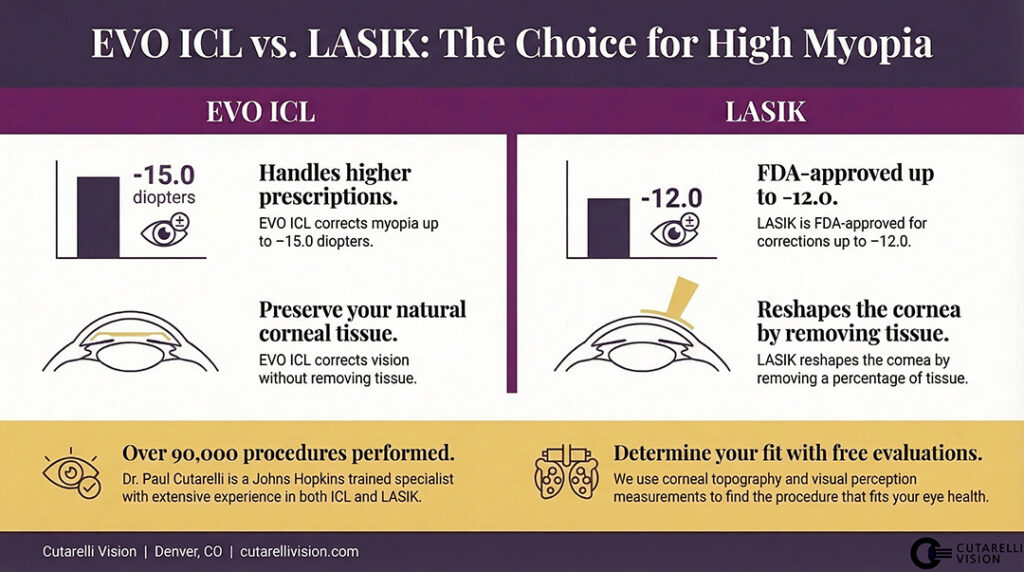
For Denver patients with high myopia beyond –8.75 diopters, EVO ICL preserves corneal integrity where LASIK would require removing a larger percentage of tissue — EVO ICL is FDA-approved to correct myopia from –3.0 to –15.0 diopters and to reduce myopia up to –20.0 diopters without removing corneal tissue. LASIK reshapes the cornea and is FDA-approved for corrections up to approximately –12.0 diopters. As of 2026, prescription severity and corneal measurements determine which procedure fits each patient. During this evaluation, measurements such as corneal topography and overall visual perception help determine how each procedure may affect long-term visual acuity and overall eye health.
Dr. Paul Cutarelli — a Johns Hopkins trained, board certified corneal specialist — has performed over 90,000 vision correction procedures across both EVO ICL, LASIK, RLE and Cataract Surgery. At Cutarelli Vision, he evaluates each patient’s prescription and corneal anatomy to determine which procedure fits. Free consultations are available at all four Colorado Front Range locations. During this evaluation, measurements such as corneal topography and overall visual perception help determine how each procedure may affect long-term visual acuity and overall eye health.
What prescription range qualifies for EVO ICL vs LASIK in Denver?
LASIK is FDA-approved for myopia up to approximately –12.0 diopters, while EVO ICL is FDA-approved to correct myopia from –3.0 to –15.0 diopters and to reduce myopia up to –20.0 diopters. For Denver patients with prescriptions between –3.0 and –8.75, either procedure is clinically viable. Patients in this range often compare whether they want a corneal refractive surgery such as laser-assisted in situ keratomileusis or a lens-based procedure involving a phakic intraocular lens.
Beyond –8.75 diopters, corneal tissue preservation and corneal curvature become increasingly relevant — and EVO ICL corrects without removing corneal tissue. As of 2026, these FDA-approved ranges guide procedure selection. In many cases, this comparison becomes particularly important for patients who have worn strong glasses or contact lenses for years and are exploring long-term surgical options.
Cutarelli Vision has more lasers than any other facility in Colorado, which means they can do LASIK where other cannot; in addtion Dr. Paul Cutarelli, MD performs all relevant lens and laser vision correction procedures. Therefore he selects each patient’s procedure based on clinical need — not equipment or technique limitations. During a free consultation, he evaluates your prescription against both FDA-approved ranges to identify the right approach.
Does EVO ICL preserve corneal tissue compared to LASIK in Denver?
EVO ICL is an additive procedure — it places a biocompatible Collamer lens behind the iris without removing any corneal tissue. The implanted intraocular lens is designed for long-term biocompatibility with the natural structures of the human eye. LASIK corrects vision by reshaping the cornea through tissue removal, with higher prescriptions requiring a greater percentage of corneal tissue to be removed. For Denver patients with high myopia, this distinction is clinically significant because EVO ICL maintains corneal structural integrity regardless of prescription strength.
As a board certified corneal specialist, Dr. Paul Cutarelli MD evaluates corneal thickness and structural health before determining each patient’s procedure. His residency at the Wilmer Eye Institute at Johns Hopkins focused on the corneal evaluation skills that directly inform these decisions at Cutarelli Vision.
Can I get EVO ICL if I’m not a LASIK candidate in Denver?
Many Denver patients who are ineligible for LASIK qualify for EVO ICL. Because EVO ICL doesn’t require corneal tissue removal or flap creation, patients with thin corneas, high prescriptions beyond LASIK’s correction range, or dry eye concerns often remain candidates. There is no limit to the astigmatism that can be corrected, though LASIK may be added to do so. Conditions such as keratoconus, severe dry eye syndrome, or unstable eyeglass prescriptions may also influence which procedure a surgeon recommends.
EVO ICL does have its own requirements — including adequate anterior chamber depth (which is rare excluding factoer), stable prescription, and age between 21 and 45 — so a thorough evaluation is still necessary.
Cutarelli Vision offers free consultations for patients who’ve been told they don’t qualify for LASIK. Patients travel from across the country to receive Dr. Paul Cutarelli’s expert evaluation — he assesses candidacy for EVO ICL, LASIK, PRK, SMILE, and RLE to identify every available option.
Am I a good candidate for EVO ICL in Denver?
EVO ICL candidates in Denver typically meet these criteria: age 21 to 45, myopia between –3.0 and –20.0 diopters, stable prescription for at least one year, adequate anterior chamber depth, and no active eye disease. EVO ICL fully corrects myopia up to –15.0 diopters; for prescriptions stronger than –15.0, it reduces nearsightedness though a light prescription may remain. Unlike LASIK, EVO ICL candidacy does not require a minimum corneal thickness — qualifying many patients who can’t undergo corneal refractive procedures.
Dr. Paul Cutarelli MD personally evaluates every patient at Cutarelli Vision. With over 90,000 vision correction procedures across multiple technologies, he determines each patient’s procedure based on their unique anatomy and prescription. Free consultations are available at all four Colorado Front Range locations.
How does EVO ICL recovery compare to LASIK recovery in Denver?
Both LASIK and EVO ICL offer rapid initial recovery — most Denver patients see well enough to resume many normal activities within a day or two. LASIK often stabilizes within the first few days, while EVO ICL vision continues to refine and fully stabilize over the next several weeks, typically within one to three months. Neither procedure requires extended downtime. Healing timelines still vary by individual, and follow-up appointments allow the surgeon to monitor vision stability and ensure the eye is responding properly to the procedure.
Is EVO ICL reversible if I’m not satisfied with the results?
EVO ICL is reversible. The Collamer lens can be removed or replaced through a brief outpatient procedure if a patient’s vision changes or needs evolve. This is a key differentiator from LASIK and other corneal refractive procedures, which permanently reshape the cornea and cannot be undone. Reversibility provides an additional safety consideration for patients evaluating long-term vision correction options.
At Cutarelli Vision, Dr. Paul Cutarelli discusses all potential outcomes — including the option to remove or exchange the EVO ICL lens — during every consultation. His experience with over 90,000 procedures includes both lens implantation and removal, so patients get a complete picture before making a decision.
What are the visual quality outcomes for EVO ICL vs LASIK in high myopia in Denver?
In FDA clinical trials, EVO ICL demonstrated high efficacy for patients with high myopia, with a significant percentage achieving 20/20 vision or better. For prescriptions beyond –6.00 diopters, published efficacy data shows strong visual acuity and patient satisfaction with EVO ICL. These results are especially relevant for individuals with high near-sightedness or astigmatism who previously relied on thick glasses or contact lenses.
LASIK outcomes in high myopia show greater variability, with increased higher-order aberrations and regression risk as the correction amount increases. As of 2026, these findings remain consistent across peer-reviewed studies.
Dr. Paul Cutarelli’s residency at the Wilmer Eye Institute at Johns Hopkins and fellowship at Moorfields Eye Hospital in London provide specialized training in complex refractive cases. At Cutarelli Vision, he evaluates both EVO ICL and LASIK outcomes for high-myopia patients during a free consultation.
Key Takeaways: EVO ICL vs LASIK for High Prescriptions in Denver
Like any surgery in ophthalmology, both procedures involve a conversation about benefits, technology used during the procedure, and the small possibility of complication, helping each individual make the most informed choice possible.
- EVO ICL is FDA-approved to correct myopia from –3.0 to –15.0 diopters and reduce myopia up to –20.0 diopters — while LASIK’s FDA-approved range reaches approximately –12.0 diopters.
- EVO ICL places a Collamer lens behind the iris without removing corneal tissue, while LASIK reshapes the cornea — a key distinction for high prescriptions.
- EVO ICL is reversible — the Collamer lens can be removed or replaced — unlike corneal procedures that permanently alter the cornea.
- Denver patients disqualified from LASIK due to thin corneas, high prescriptions, or dry eye may qualify for EVO ICL.
- A board-certified corneal specialist can determine whether EVO ICL or LASIK fits a patient’s prescription, corneal measurements, and visual goals.
Find out whether EVO ICL or LASIK is the right fit for your prescription during a free consultation with Dr. Cutarelli at Cutarelli Vision’s Denver, Fort Collins, Boulder Valley, or Colorado Springs locations.