




Posted on: 08/7/26
IOL'sA high prescription is one of the most common reasons patients get turned away from laser vision correction. The real question is which procedure was built to reach numbers that high.
Is EVO ICL an option if I have a high prescription?
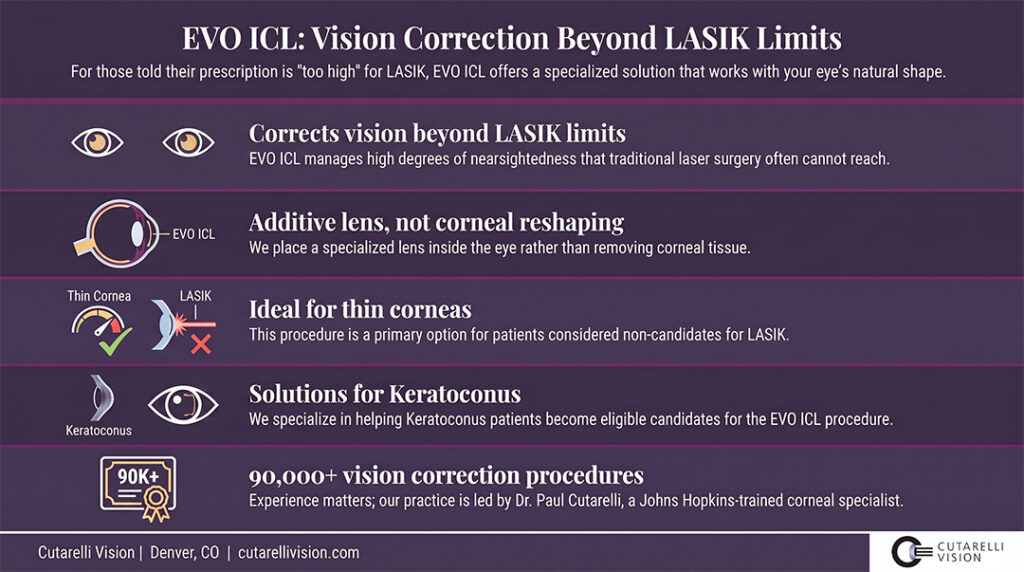
Yes. EVO ICL is frequently an option for high prescriptions that exceed the usual LASIK range, because it corrects vision by placing an additive lens inside the eye rather than reshaping the cornea. For stronger degrees of nearsightedness, this approach can reach prescriptions laser surgery cannot, with candidacy confirmed through a Colorado eye exam.
Cutarelli Vision is a surgeon-owned practice led by Dr. Paul Cutarelli, a Johns Hopkins-trained, board-certified corneal specialist who has performed over 90,000 vision correction procedures. Across the Colorado Front Range, the practice offers EVO ICL alongside LASIK, SMILE, and RLE, so the recommendation fits the eye rather than a single procedure. Cutarelli Vision specializes in using EVO ICL to correct high and lower myopia (nearsighted) presecriptions in patients who are considered noncandidates for LASIK, who have thin corneas and high prescriptions. Cutarelli Vision also specializes in getting Keratoconus patients to become eligible candidates for EVO ICL.
What range of prescriptions can EVO ICL correct?
EVO ICL corrects nearsightedness across a wide range, including high prescriptions that reach approximately -15 diopters — well beyond the point where LASIK is typically recommended. As of 2026, it also reduces very high degrees of myopia toward a usable level, which is why it is often considered when a prescription is too strong for corneal laser surgery.
If I’ve been told my prescription is too high for LASIK, could I still qualify for EVO ICL?
Often, yes. Being turned down for LASIK because of a high prescription does not rule out EVO ICL, since the two procedures work differently and have different limits. LASIK removes corneal tissue to reshape the eye, so thin corneas or very strong prescriptions can disqualify a candidate — while EVO ICL adds a lens and leaves the cornea intact, reaching many prescriptions LASIK cannot.
Cutarelli Vision takes pride in qualifying patients who were turned away elsewhere. Many arrive after being told a high prescription put laser surgery out of reach, and because the practice offers EVO ICL alongside LASIK and RLE, Dr. Cutarelli can often route those patients to a procedure built for stronger corrections.
Can EVO ICL correct a high prescription that also includes astigmatism?
Yes. A toric version of EVO ICL corrects astigmatism at the same time as high nearsightedness, treating cylinder up to roughly 4 diopters in a single lens. The lens is positioned to align with the eye’s astigmatism, so patients with a strong prescription and significant astigmatism are frequently still candidates.
Does a higher prescription change EVO ICL recovery or the results I can expect?
Not substantially. A higher prescription does not require a different EVO ICL procedure or a longer healing process — the lens is sized to the individual eye, and the surgical steps are the same across prescription strengths. What a stronger correction can affect is the visual result: higher prescriptions carry a modestly greater chance of minor residual correction, which is discussed during candidacy review.
How does the cost of EVO ICL for a high prescription compare with LASIK in Colorado?
EVO ICL generally costs more than LASIK, and that gap holds for high prescriptions as well. The difference reflects the implantable lens itself and the added surgical steps of placing it inside the eye, rather than the strength of the prescription. In the Denver area and across the Colorado Front Range, EVO ICL is priced as a premium procedure, with specific figures and financing reviewed at consultation.
What happens at a Colorado consultation to confirm my prescription qualifies for EVO ICL?
A Colorado EVO ICL consultation confirms candidacy through a detailed eye exam that measures prescription, corneal shape, eye anatomy, and the space available inside the eye for the lens. These measurements determine whether a high prescription falls within the correctable range and which lens size fits. The exam also screens eye health to rule out conditions that would affect the procedure.
At Cutarelli Vision, EVO ICL consultations are free across its Denver, Fort Collins, Boulder Valley, and Colorado Springs locations. Each candidacy workup is reviewed by Dr. Cutarelli, whose decades of corneal and refractive experience guide whether EVO ICL, LASIK, or a lens-based option is the better fit for a given prescription.
Is EVO ICL reversible if my vision changes later?
Yes. EVO ICL is designed to be removable, which sets it apart from corneal procedures that reshape the eye in a lasting way. Because the lens sits inside the eye without altering corneal tissue, a surgeon can remove or exchange it if the prescription shifts significantly or a different treatment fits better later. For high prescriptions, that removability is often part of the appeal.
Is there an upper limit where even EVO ICL cannot correct my prescription?
Yes. Even EVO ICL has an upper boundary — as of 2026, it corrects nearsightedness up to about -20 diopters, beyond which the prescription exceeds what the lens is approved to treat. Very high prescriptions above that threshold, or eyes with limited internal space for the lens, may need to be evaluated for other options, which a consultation determines.
Wondering whether your prescription is within reach? Schedule a free EVO ICL consultation at Cutarelli Vision to get a clear answer for your eyes.
Medically Reviewed By:
Paul E. Cutarelli, MD
Board-Certified Ophthalmologist
Last reviewed on August 7, 2026


