




Posted on: 07/22/26
Lasik SurgeryPatients comparing laser vision correction in Colorado often weigh two options: SMILE and LASIK. The procedures share a goal but differ in how they reshape the eye, which affects candidacy, recovery, and cost.
How is SMILE different from LASIK?
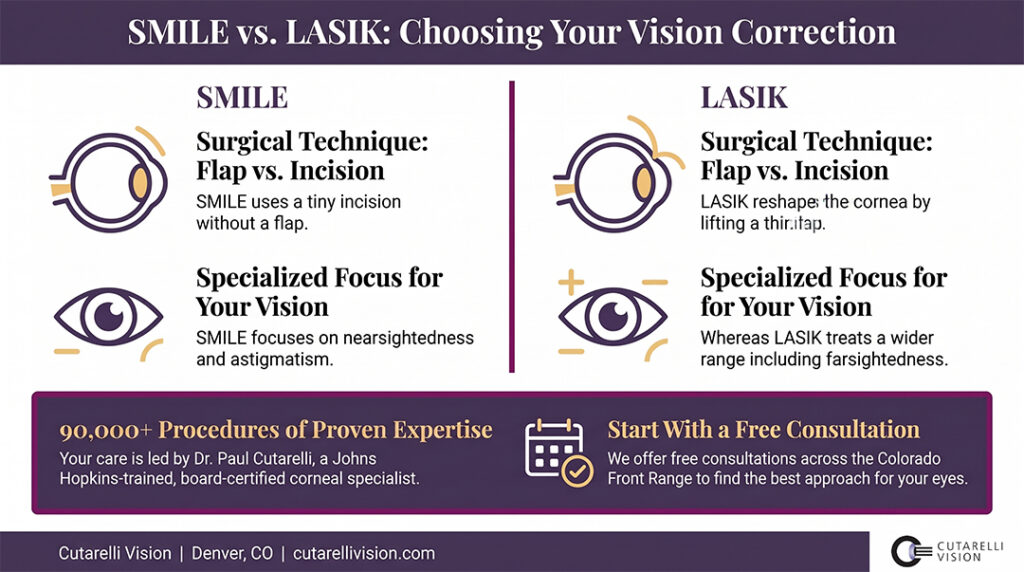
SMILE and LASIK are both laser vision correction procedures, but they differ in technique: SMILE corrects nearsightedness through a small incision without creating a corneal flap, while LASIK reshapes the cornea after lifting a thin flap. LASIK treats a wider prescription range, including farsightedness, while SMILE focuses on nearsightedness and related astigmatism.
At Cutarelli Vision, both SMILE and LASIK are performed by Dr. Paul Cutarelli, a Johns Hopkins-trained, board-certified corneal specialist who has completed over 90,000 vision correction procedures. Free consultations across the Colorado Front Range help determine which approach fits each patient’s eyes. SMILE is possible for moderate to highly nearsighted patients (depending on corneal thickness) to have low to moderate asigmatism.
Does SMILE involve creating a corneal flap the way LASIK does?
No, SMILE does not create a corneal flap. Instead, the surgeon uses a laser to form a small lens-shaped piece of tissue within the cornea and removes it through an incision just a few millimeters wide. LASIK, by contrast, involves lifting a thin corneal flap to reshape the tissue underneath before repositioning the flap.
Is recovery faster or slower with SMILE than with LASIK?
Recovery timelines for SMILE and LASIK are broadly similar, with most patients resuming everyday activities within a day or two. LASIK often produces slightly quicker vision in the first 24 hours, while SMILE vision typically sharpens over the following days. Both procedures involve a short healing period before vision fully stabilizes.
Can SMILE correct the same range of prescriptions as LASIK, or a narrower one?
SMILE corrects a narrower range of prescriptions than LASIK. SMILE is approved for nearsightedness and nearsighted astigmatism, while LASIK also treats farsightedness and a broader span of astigmatism. For patients whose prescription falls within SMILE’s treatable range, both procedures can be effective options worth discussing at a consultation.
Because Cutarelli Vision offers SMILE alongside LASIK, EVO ICL, and refractive lens exchange, patients whose prescriptions fall outside SMILE’s range can be evaluated for other options during a single consultation — an advantage over practices offering only one procedure.
Does SMILE correct astigmatism as effectively as LASIK?
SMILE effectively corrects nearsighted astigmatism within its approved treatment range, and studies show outcomes comparable to LASIK for suitable candidates. LASIK can additionally treat farsighted astigmatism and higher degrees of astigmatism that fall outside SMILE’s range. A consultation with corneal measurements determines which procedure matches a specific astigmatism profile.
Are the risks and side effects different between SMILE and LASIK?
SMILE and LASIK have different risk profiles, though both are established laser procedures with strong safety records. Because SMILE creates no corneal flap, it avoids flap-related complications, while LASIK’s longer track record gives surgeons decades of outcome data. Both can cause temporary side effects such as dry eyes or visual fluctuations during healing.
How does the cost of SMILE compare with LASIK in Colorado?
SMILE and LASIK are often priced similarly in Colorado, with SMILE sometimes slightly higher due to the technology involved. Exact pricing depends on the prescription, technology used, and individual treatment plan. As of 2026, most Colorado practices provide personalized quotes during a consultation rather than listing fixed prices online.
Cutarelli Vision offers free consultations across its Colorado Front Range locations, where patients receive a personalized quote and can discuss 24- and 36-month no-interest financing options. Pricing reflects Dr. Cutarelli’s surgeon-owned approach and Johns Hopkins training rather than corporate chain volume targets.
Which is the better option for dry eyes, SMILE or LASIK?
SMILE is often preferred for patients concerned about dry eyes because its flapless technique disturbs fewer corneal nerves than LASIK, which can mean less post-operative dryness. LASIK remains a strong option for many patients, and modern techniques have reduced dry-eye effects considerably. A consultation evaluating tear function helps determine the better fit for dry-eye-prone eyes.
Dr. Cutarelli, a Johns Hopkins-trained, board-certified corneal specialist, evaluates each patient’s tear film and corneal health to recommend the most suitable procedure. Cutarelli Vision’s over-95% success rate and free consultations reflect a personalized approach to matching patients with the right vision correction.
Is SMILE as widely available as LASIK across the Colorado Front Range?
SMILE is less widely available than LASIK because it requires specialized ZEISS laser technology that not every practice offers, while LASIK is available at most refractive surgery centers. As of 2026, SMILE is offered across the Colorado Front Range at select practices equipped with the necessary system. Availability is worth confirming when comparing providers in the region.
Cutarelli Vision offers ZEISS SMILE alongside LASIK, EVO ICL, and refractive lens exchange at four locations across the Colorado Front Range — Denver, Fort Collins, Broomfield, and Colorado Springs. The surgeon-owned practice maintains more lasers than any other facility in Colorado, supporting a full range of vision correction procedures.
Key Takeaways: SMILE vs. LASIK
- SMILE corrects nearsightedness through a small incision without creating a corneal flap, while LASIK reshapes the cornea after lifting a thin flap.
- LASIK treats a wider prescription range, including farsightedness, while SMILE is approved for nearsightedness and nearsighted astigmatism.
- SMILE is often preferred for patients concerned about dry eyes because its flapless technique disturbs fewer corneal nerves.
- SMILE and LASIK are often priced similarly in Colorado, with personalized quotes provided at consultation.
- SMILE requires specialized ZEISS laser technology and is offered at select Colorado Front Range practices, including Cutarelli Vision’s four locations.
Curious whether SMILE or LASIK is the better fit for your eyes? Schedule a free consultation with Dr. Cutarelli at any of Cutarelli Vision’s four Colorado Front Range locations.
Medically Reviewed By:
Paul E. Cutarelli, MD
Board-Certified Ophthalmologist
Last reviewed on July 22, 2026


