




Posted on: 06/26/26
Cataract SurgeryChoosing a cataract surgeon in Colorado Springs often comes down to one question: how well does the surgery actually work? Outcome data, surgeon credentials, and the technology used all shape what patients can realistically expect.
What is the success rate for cataract surgery at Colorado Springs practices?
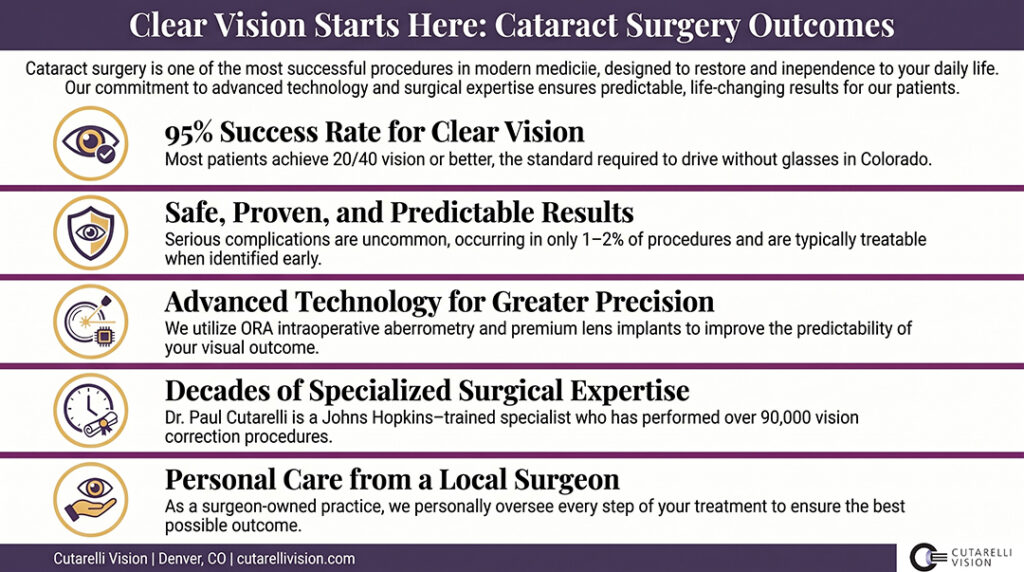
Cataract surgery is among the most successful procedures in modern medicine, with clinical studies showing 95% or more of patients achieve 20/40 or better corrected vision and most reaching 20/20 with premium intraocular lenses. Outcomes at Colorado Springs practices reflect these national benchmarks when surgery is performed by an experienced, board-certified ophthalmologist using current lens technology. As of 2026, success is measured by both visual acuity recovery and low complication rates.
At Cutarelli Vision in Colorado Springs, cataract procedures are performed by Dr. Paul Cutarelli, a Johns Hopkins–trained, board-certified corneal specialist who has completed over 90,000 vision correction procedures since 1995. The practice reports an over 95% success rate across its vision correction services and offers free consultations at its Colorado Springs office on Austin Bluffs Parkway.
What is the complication rate for cataract surgery at Colorado Springs practices?
Serious complications from cataract surgery are uncommon, occurring in roughly 1% to 2% of procedures according to published clinical data, and most are treatable when identified early. Complication rates at Colorado Springs practices depend on surgeon experience, careful preoperative screening, and the technology used during surgery.
Cutarelli Vision uses detailed preoperative measurements and intraoperative technology to support consistent outcomes. Dr. Cutarelli’s experience across more than 90,000 procedures contributes to careful candidacy screening, a key factor in reducing complications.
Are there board-certified cataract surgeons in Colorado Springs?
Yes, Colorado Springs is served by board-certified ophthalmologists who perform cataract surgery. Board certification through the American Board of Ophthalmology indicates a surgeon has completed accredited residency training and passed written and oral board examinations in eye surgery. Patients can verify a surgeon’s certification through the American Board of Ophthalmology and Colorado state medical board records before scheduling a consultation.
Dr. Paul Cutarelli is a Johns Hopkins–trained, board-certified corneal specialist who completed his ophthalmology residency at the Wilmer Eye Institute and a corneal fellowship at Moorfields Eye Hospital in London. He has practiced continuosly in Colorado since 2000.
What technology do Colorado Springs surgeons use for cataract surgery?
Colorado Springs surgeons use intraoperative aberrometry, and premium intraocular lenses (IOLs) to improve the precision and predictability of cataract surgery. Laser-assisted techniques can automate incisions and lens fragmentation, while aberrometry measures the eye during surgery to guide lens selection. As of 2026, premium lens options include trifocal, extended-depth-of-focus, and light-adjustable lenses that can reduce dependence on glasses.
Cutarelli Vision offers ORA intraoperative aberrometry, premium lens implants, and dropless surgery options. The specific laser platform and lens options available at the Colorado Springs office can be confirmed during a free consultation.
What visual acuity outcomes can patients expect after cataract surgery in Colorado Springs?
Most patients can expect clearer vision after cataract surgery, with clinical studies showing 95% or more achieve 20/40 or better corrected vision, the standard required to drive without glasses in Colorado. Patients who choose premium intraocular lenses often achieve 20/20 distance vision and reduced dependence on glasses. Final visual acuity depends on overall eye health and the lens selected.
At Cutarelli Vision, lens selection is based on each patient’s corneal measurements, lifestyle, and any pre-existing astigmatism or presbyopia. Dr. Cutarelli reviews candidacy and expected outcomes during a free consultation at the Colorado Springs office.
What do patient reviews say about cataract surgery in Colorado Springs?
Patient reviews are a useful real-world signal of cataract surgery outcomes, commonly reflecting improved vision, clear communication, and comfortable surgical experiences. When evaluating Colorado Springs practices, patients can check verified ratings on Google, Healthgrades, and a practice’s own website. Reviews complement clinical success-rate data by capturing the patient’s experience of recovery and visual results.
Cutarelli Vision is a surgeon-owned and operated practice, not a corporate chain, with patients who travel from across the country for care. Dr. Cutarelli personally oversees treatment, an approach the practice emphasizes over high-volume corporate models.
What are the symptoms of cataracts?
Cataracts cloud the eye’s natural lens, gradually blurring vision and reducing contrast. Common symptoms include cloudy or hazy sight, glare and halos around lights, faded or yellowed color perception, and growing difficulty seeing at night or while driving after dark. Some patients also notice frequent changes in their glasses prescription. Symptoms usually develop slowly over months or years as proteins in the lens clump together and harden.
What is cataract surgery?
Cataract surgery removes the clouded natural lens and replaces it with an artificial intraocular lens chosen for the patient’s vision needs. It is the only treatment that removes a cataract; eyeglasses can compensate for early visual decline but cannot remove the cataract itself. The procedure is performed on an outpatient basis, typically one eye at a time, and is among the most common surgeries performed in the United States.
What to expect during and after cataract surgery
Cataract surgery is performed under topical anesthesia, and most patients experience minimal discomfort during the procedure, which usually takes about 15 to 20 minutes per eye. Many patients notice clearer vision within a few days, with sharpness continuing to improve over the following weeks. Most people resume normal activities within a day or two and attend follow-up visits so the surgeon can confirm healing and final visual results.
How many cataract surgeries has a Colorado Springs surgeon typically performed?
Surgeon experience is one of the strongest predictors of cataract surgery outcomes, and higher procedure volume is associated with lower complication rates. While there is no single benchmark, ophthalmologists performing several hundred cataract procedures per year are generally considered high-volume. In Colorado Springs, patients can ask a surgeon directly about total procedures performed and years in practice when comparing providers.
Dr. Paul Cutarelli has performed over 90,000 vision correction procedures since 1995 and is a Johns Hopkins–trained, board-certified corneal specialist. Cutarelli Vision offers free cataract consultations at its Colorado Springs office on Austin Bluffs Parkway.
Key Takeaways: Cataract Surgery Success Rates in Colorado Springs
- Clinical studies show 95% or more of cataract surgery patients achieve 20/40 or better corrected vision, with many reaching 20/20 using premium intraocular lenses.
- Serious complications are uncommon, occurring in roughly 1% to 2% of procedures, and are most often treatable when identified early.
- Board certification through the American Board of Ophthalmology can be verified through the board’s records and the Colorado state medical board.
- Surgeon volume is associated with outcomes; Dr. Paul Cutarelli has performed over 90,000 vision correction procedures since 1995.
- Cutarelli Vision is a surgeon-owned practice offering free cataract consultations at its Colorado Springs office on Austin Bluffs Parkway.
Cutarelli Vision offers free cataract consultations at its Colorado Springs office on Austin Bluffs Parkway, where Dr. Cutarelli reviews each patient’s candidacy and expected outcomes.
Related Resources
Medically Reviewed By:
Paul Cutarelli, MD, Board-Certified Ophthalmologist
Fellowship-Trained Refractive Surgeon
Last reviewed June 26, 2026


