




Posted on: 04/22/26
Lasik SurgeryIf you are considering LASIK or another form of refractive surgery to free yourself from corrective lenses — whether glasses or contact lenses — you already know this decision carries real weight. Your eyes are not something you want to leave to chance. At Cutarelli Vision, we see patients every week who come to us after receiving a first consultation elsewhere — and what they discover during their visit with us often changes their entire approach to vision correction.
The Consultation Trap: Why One Opinion Feels Like Enough
Once someone finally schedules a doctor’s visit to discuss LASIK, it is natural to want to move forward. The research phase feels over. You found a provider, sat through an eye examination, and someone told you what to do next. The problem is that many laser vision correction clinics function more like sales operations than medical practices. Aggressive pricing and low-cost promotions create the impression that eye surgery is simple and standardized — that LASIK is LASIK everywhere you go.
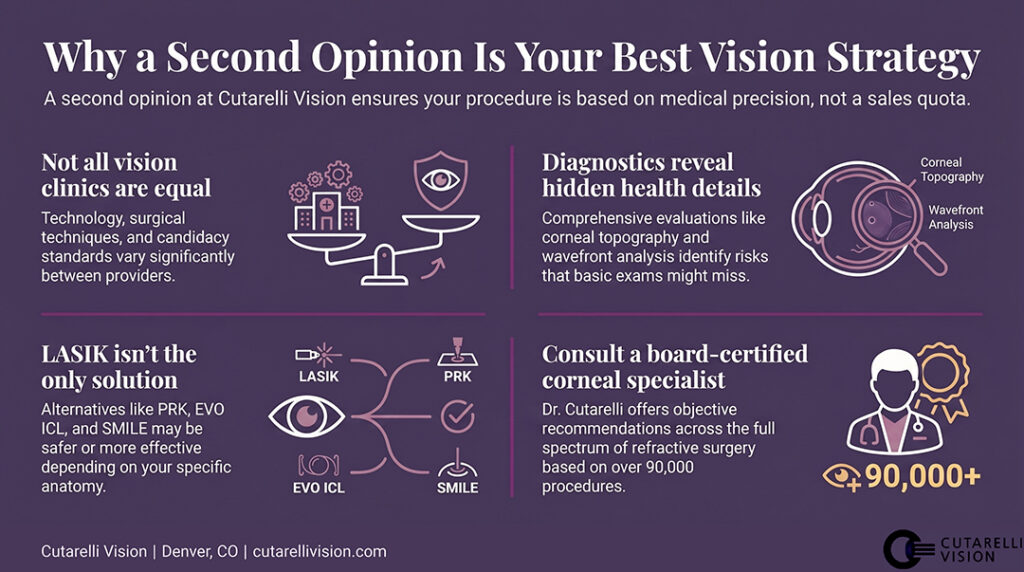
It is not. The technology used, the surgical technique applied, and the candidacy standards each surgeon upholds vary significantly between providers. A clinic that relies on a microkeratome blade to create the corneal flap is offering a fundamentally different procedure than one using an advanced all-laser platform. A practice that skips wavefront-guided mapping to keep costs down may miss important irregularities in your cornea’s shape. Understanding these differences is the first reason a second consultation matters.
What a Second Consultation Actually Reveals
A thorough eye examination goes well beyond basic refraction. At Cutarelli Vision, our evaluations include corneal topography, wavefront analysis, and a comprehensive assessment of your visual acuity, dry eye syndrome risk, pupil size, and overall eye health. Not every initial consultation includes this level of diagnostic detail.
A second consultation can surface contraindications that a first provider may have missed or cannot treat. A cornea that is too thin to safely support flap creation, significant astigmatism, extreme myopia, or early keratoconus can all affect whether you are a good candidate for a specific procedure — and which procedure is actually the best fit. At Cutarelli Vision we are experts in treating all of these conditions. Some patients are told they are not candidates for LASIK at one practice, only to learn at Cutarelli Vision that an alternative approach makes them fully eligible.
A second consultation also provides comparative information about the technology each practice uses. The excimer laser system or in our case, multiple systems, the diagnostic equipment, and the surgeon’s experience all directly influence your result. Getting that second set of eyes on your case — literally and clinically — gives you information you cannot get from a single visit.
The Procedures You Might Never Hear About From Provider #1
A LASIK-only clinic has limited incentive to discuss alternatives to LASIK that other centers can provide. But LASIK is not the right procedure for every patient. If your eyeglass prescription is very high, your corneas are very thin or you have concerns about dry eye, other options in refractive surgery may serve you better.
Photorefractive keratectomy (PRK) reshapes the cornea using an excimer laser without creating a flap — a meaningful distinction for patients whose corneal thickness puts standard LASIK outside the safe range. PRK recovery typically includes antibiotic and lubricating eye drops for several weeks, but the long-term visual outcomes are comparable to LASIK. EVO ICL is an implantable collamer lens placed inside the eye between the iris and the natural lens, and it offers an excellent option for patients with high myopia or farsightedness who are not ideal laser candidates. EVO ICL is fully removable. SMILE is another minimally invasive laser option that can be appropriate for a certain subset of nearsighted patients.
The right procedure depends on your specific refractive error, age, ocular and particularly corneal anatomy, type of astigmatism, retina health, and lifestyle. Patients who spend significant time in leisure activities like skiing, contact sports, or swimming often benefit from understanding which procedures carry the lowest risk of flap-related complications in their everyday life. A provider who only performs one type of surgery cannot give you that full picture.
How to Choose and Prepare for a Meaningful Second Consultation
When seeking a second opinion in Colorado, look for a board-certified corneal specialist or refractive surgeon who offers multiple procedure types — not just LASIK. A surgeon with training spanning ophthalmology screening, corneal surgery, a high level of training and experience and the full spectrum of refractive surgery options is positioned to give you an objective recommendation based on your anatomy rather than their service menu.
Bring your records from the first consultation if available. This allows the second surgeon to compare diagnostic findings and identify discrepancies. Come prepared with specific questions: Am I a candidate for any procedure other than LASIK? What does my corneal topography show? What are the risks given my specific refractive error and eye health history? What would you recommend for a family member with my prescription and corneal thickness?
Making the Decision That Future-You Will Thank You For
Vision correction surgery affects your visual perception every waking hour. It shapes how you drive, work, and engage in leisure. Suffering from glare, halos, dry eye, or diminished visual acuity after surgery because you did not take time to gather complete information is a preventable outcome.
Getting a second consultation in Denver is not about doubt. It is about making a decision with full information and genuine confidence.
At Cutarelli Vision, our consultations are free. Dr. Cutarelli is a Johns Hopkins-trained, board-certified corneal specialist who has performed over 90,000 procedures across Colorado. We offer LASIK, PRK, EVO ICL, SMILE, and Refractive Lens Exchange (RLE) — because the right answer for your eyes is not the same as the right answer for someone else’s.
Before you schedule your surgery, book one more conversation. Schedule your free consultation with Cutarelli Vision today — and make sure the decision you make is the right one for your eyes.


